- T Collective Monthly
- Posts
- The double-edged sword called “freelance” 🗡️
The double-edged sword called “freelance” 🗡️
Let’s cut to the chase

Tricia Mirchandani
September 18, 2025
Are all of the things that we value most about freelance or contract work the very things that often overextend us?
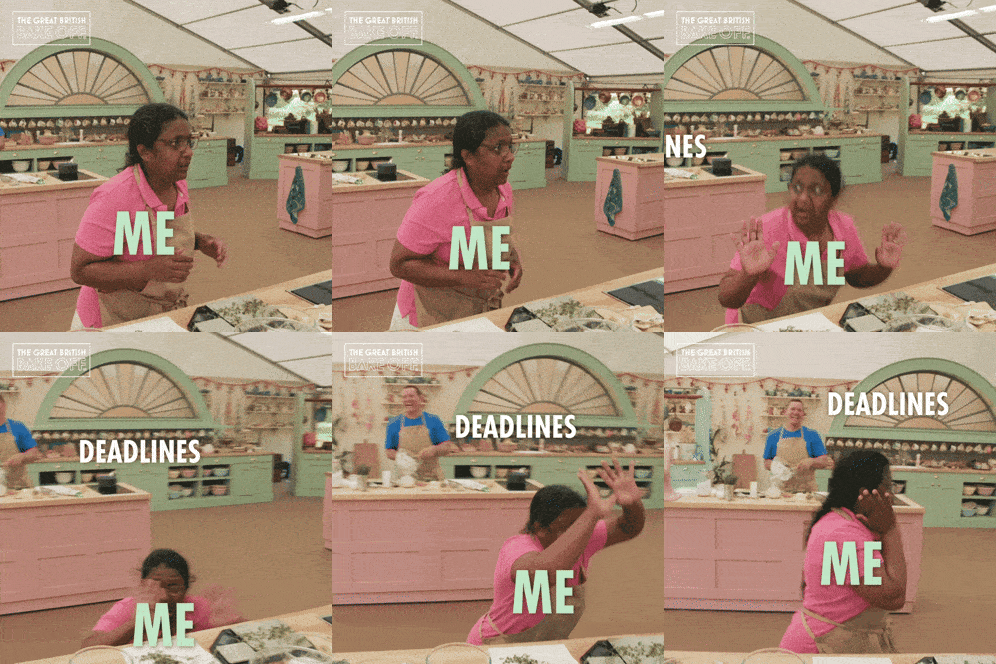
Gif by britishbakeoff on Giphy
As a freelancer or contractor, your small talk likely includes some combination of phrases like “It gives me more freedom,” “I make my own schedule,” “There’s no micromanagement,” “You make way more (and spend less on gas),” “I don’t have to get up extra early to get myself ready or pack a lunch,” — and so on.
But is it possible that these advantages can put us at a disadvantage?
Some are universal and easy to translate:
“I make my own schedule” so often means “I’ll wrap this up after the kids go to bed” or “I’ll log on early tomorrow to make some progress on this deck.”
“There’s no micromanagement” can be decoded as “I have to be on it all day, every day (and it’s exhausting).”
“It gives me more freedom” is much more endearing than “I can work from anywhere, so I don’t have to lose money to take time off.”
But others are more personal and nuanced, requiring us to navigate them on our own. The list is a long one, but here are our top five.
Finding the balance between passion, expertise, and compromise (even when you know better).
Creatives are rarely their own audience. We create for the clients and their audiences (or at least, who the client believes their audience to be). How many times have you poured your heart and soul into your work, endlessly reworking the details — only to receive feedback that’s prescriptive, weakens the message, or wrings the design dry? Most of the time, our job is to give the people what they want. But many of us also feel responsible for delivering work that will produce results and make an impact. Our rule of thumb: Be selective about which hills to die on (we opt to take the stand where it matters most).
Identifying and then creating the lines where your job begins and ends, and getting your clients aligned.
We know that the terms “freelancer” and “contractor” are not synonymous with “jacks (or janes) of all trades,” but do they? Oftentimes, no. When you’re somewhat of an island, especially when your expertise extends even an inch beyond your skill set (good for you, btw!), you may find that the parameters of your role become a gray area over time. It’s a freelance copywriter who excels at juggling multiple projects and now finds themselves equal parts copywriter and project manager. It’s an independent web designer who had a knack for filling their layouts with copy in a pinch, now half web designer and half copywriter — you get the idea, and you’ve probably lived it. In our little world, there’s usually no job description, no standardized flow charts for the lifecycle of a project, and no supervisor to push back on when tasks that are out of your realm land on your desk. It’s a lesson in knowing when to say no, when to delegate (if you can), and how to protect your island so that you can do what you do best.
Going to bat when you’re the only one on the bench.
This is a particularly daunting task when you’re a freelancer who is tapped in to work on an already existing team. On good days, you’re a bit of an outlier. On other days, you’re a forgotten resource (sometimes unintentionally and sometimes not). This can manifest as work you created being released into the world looking very differently than it did when you handed it over. Or it can look like members of the immediate team blatantly doing your work themselves. As with all other things, how you navigate these moments is entirely dependent on the dynamics of your working relationships. But our vote is to be heard. We're not always privy to what's happening behind the scenes — and sometimes, neither is leadership.
Collaborating with other freelancers or contractors.
We creatives are both territorial and precious about our roles and our work and we’re naturally collaborative. They’re two components that seem at odds with each other at a glance, but it all depends on the context. When everyone is working together in-house, creative partnership tends to flow into marketing magic. Trying to collaborate as independent freelancers on the other hand can be a little bit like herding cats. Each one brings different experience, different visions of what “should be,” and different schedules with varying if not inconsistent working hours. And it’s not unusual for clients to expect the same level of creative collaboration between freelancers, while also keeping them generally siloed from each other. As always, open and honest conversation with your counterparts and some intentional relationship-building can help ease the tension.
Doing your job (and doing it well) when your main point of contact is floundering.
What to do, what to do, when your go-to person is not all there to go to. As a freelancer or contractor, you’re often paired up with an individual person on the team. This person is your North Star. Need clarification or more detail? They’ve got the insight. Questions about delivery timelines? They create them. Desperate to forecast projects coming down the pipeline so you can better plan and manage your time? They’re Weather 101. But what happens when they’re underwater? Real talk: Remember to maintain the line between your job and theirs. Being the best part of their day is one thing. But taking on additional work to help them is the slipperiest of slopes.
Whether you work independently or in tandem with another (or a few ‘nothers), this is our way of letting you know that you’re not alone and the struggle really is real.
Really.
Let’s link up
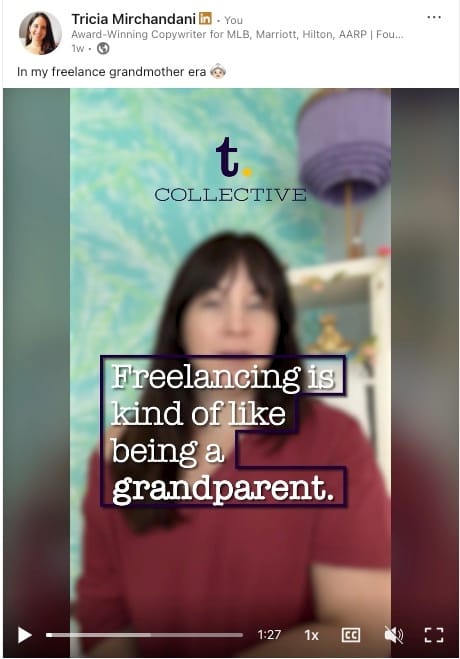
T Collective founder, Tricia Mirchandani, has worked with the best of them — and frankly, also some of the worst of them (haven’t we all). And that’s why we’re here doing what we do. But starting her own small business (which is not an agency) doesn’t mean that she’s risen above the struggles of the creative freelancer. Follow along on LinkedIn as Tricia breaks through the noise with our small but mighty creative marketing team in tow.
Work we love (that isn’t ours)
Here’s a controversial take — most of the time, less is actually better, regardless of what the client may think. Simplicity in marketing is effective for a few reasons: it’s not visually overwhelming, it feels more human and authentic, and it instantly stands out when everybody else is overcomplicating.
One of our favorite examples is this recent sale ad from Australian furniture brand Koala.
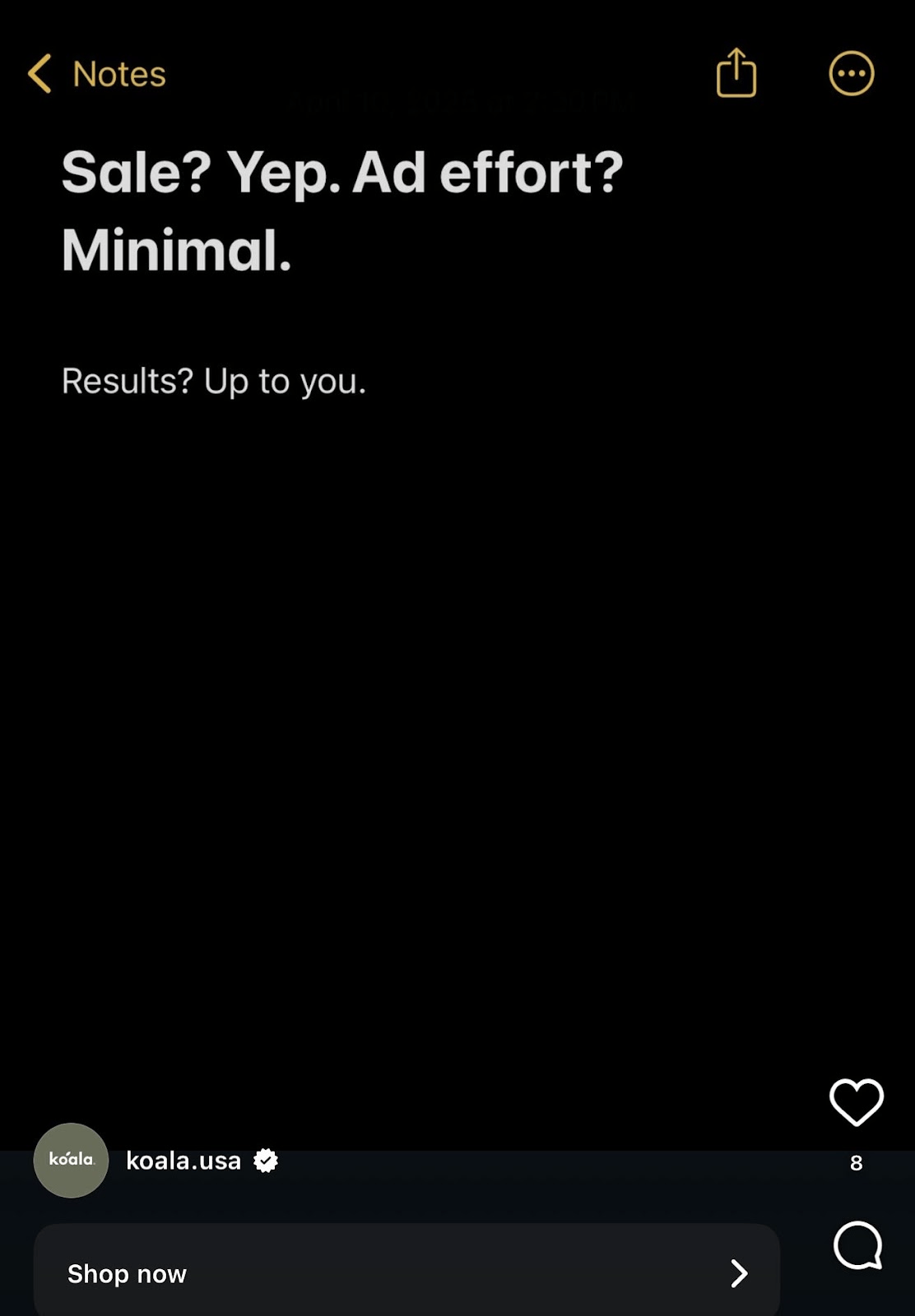
Where some might see little-to-no planning, maybe limited resources, or an overall lack of effort (it’s spelled out right there, isn’t it?), we see humanity. Can you imagine the creative at their desk, feet up, typing this in their Notes app? It’s the exact position you likely find yourself in multiple times throughout the work day. And that right there is exactly the purpose. Relatability and connection.
Someone get us the numbers from this sale! Please and thank you.
